
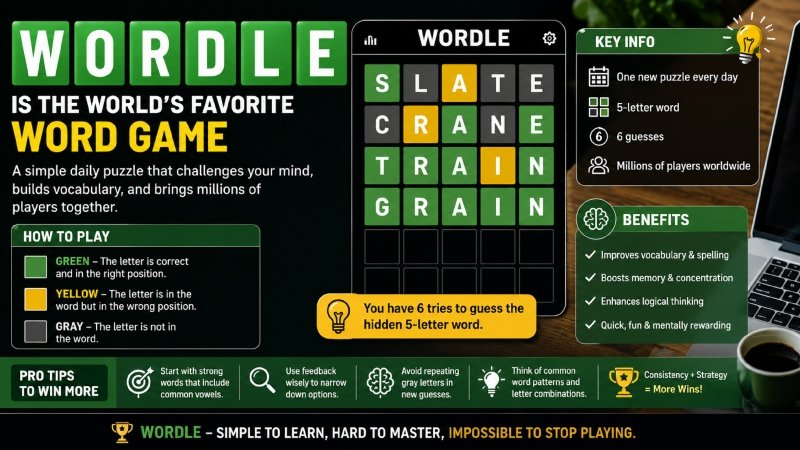
Wordle has become one of the most influential online word games of the modern era. What started as a simple daily puzzle quickly evolved into a cultural phenomenon that attracts millions of players every day. Its appeal lies in its simplicity, accessibility, and ability to challenge the mind without requiring hours of commitment.
Unlike many digital games that depend on complex mechanics or endless progression systems, Wordle focuses on a straightforward objective: guess a hidden five-letter word in six attempts or fewer. This simple concept has proven remarkably effective at engaging players of all ages. Students, professionals, retirees, and casual gamers alike have embraced the challenge, making it a daily habit.
This guide explores everything you need to know about Wordle, including how it works, why it became so successful, proven strategies for better results, benefits, limitations, and practical insights that can improve your experience.
What Is Wordle and How Does It Work?
At its core, Wordle is a daily word puzzle that challenges players to identify a secret five-letter word within six guesses. Each submitted guess generates immediate feedback through a color-coded system. A green tile indicates that a letter is correct and positioned correctly. A yellow tile shows that a letter exists in the solution but belongs elsewhere. A gray tile means the letter does not appear in the hidden word.
This feedback mechanism transforms every guess into a valuable source of information. Players use clues from previous attempts to refine their strategy and narrow possible solutions until the correct answer is found.
Wordle at a Glance
| Feature | Details |
|---|---|
| Game Type | Daily word puzzle |
| Objective | Guess a five-letter word |
| Attempts Allowed | Six guesses |
| Difficulty Level | Easy to learn, challenging to master |
| Platform | Browser-based |
| Daily Challenge | One puzzle per day |
| Skills Required | Vocabulary, logic, pattern recognition |
| Audience | Students, professionals, families, and puzzle enthusiasts |
Why the Game Became a Global Success
The success of Wordle is not accidental. Several factors combined to create an experience that resonated with millions of users. One major reason is accessibility. There are no complicated instructions, lengthy tutorials, or significant barriers to entry. Players can begin immediately and understand the core mechanics within moments.
Another important factor is the daily format. Rather than encouraging endless gameplay, the puzzle offers a single challenge each day. This creates anticipation and prevents fatigue, making each session feel meaningful.
Social sharing also contributed significantly to its growth. Players can share results without revealing answers, creating curiosity among friends, coworkers, and family members. This simple sharing system helped fuel widespread adoption across social platforms. The game’s minimalist design further enhances its appeal. There are few distractions, allowing users to focus entirely on solving the puzzle.
Best Strategies for Consistent Success
Many players approach puzzles randomly, but successful participants rely on structured strategies. The first step is selecting a strong opening word. An effective starting word contains commonly used vowels and frequently occurring consonants. This provides maximum information during the earliest stages of the puzzle.
The second step involves analyzing feedback carefully. Every color change represents valuable data. Strong players avoid rushing and instead evaluate all available clues before making another guess.
Benefits for Individual Users
One reason Wordle remains popular is the range of benefits it offers individual players. The game encourages vocabulary expansion by exposing users to different word structures and letter combinations. Over time, players become more familiar with spelling patterns and language usage.
It also strengthens logical reasoning. Every puzzle requires evaluating evidence, identifying possibilities, and making informed decisions. Another advantage is mental stimulation. Daily participation helps keep the mind active through analysis, memory recall, and pattern recognition. Many users appreciate the game’s time efficiency.
Lessons for Technical Teams and Product Designers
Beyond entertainment, Wordle provides valuable insights for technical teams, product managers, and developers. One of its most important lessons is the power of simplicity. The interface contains only essential elements, reducing friction and improving usability. The game also demonstrates effective user retention. A daily challenge encourages habitual engagement without overwhelming users with excessive notifications or rewards.
Another key takeaway involves shareability. The visual result-sharing system promotes organic growth while preserving the integrity of the puzzle. Product teams can learn from its focus on user experience. Every interaction serves a purpose, creating a seamless journey from start to finish. The game’s success highlights how thoughtful design can outperform complex feature sets when user needs remain the primary focus.
Common Mistakes That Reduce Success Rates
Many players unknowingly limit their chances of solving the puzzle. One frequent mistake is ignoring available information. Some users continue testing letters that have already been ruled out, wasting valuable opportunities. Another issue involves becoming attached to a single theory too early. Flexibility is essential because initial assumptions may prove incorrect. Players also struggle when they focus only on individual letters instead of considering overall word structure. Understanding patterns often leads to faster solutions.
Rushing through guesses can create avoidable errors. Careful analysis usually produces better outcomes than quick decisions. Avoiding these common mistakes can significantly improve performance over time.
How to Play Responsibly and Safely
Although the game is generally safe, maintaining healthy digital habits remains important. Players should avoid spending excessive time searching for answers online before attempting the puzzle independently. The challenge is most rewarding when solved through personal effort. Parents may also use the game as an educational tool, helping younger users develop language skills while practicing critical thinking.
The Lasting Impact of Wordle
The influence of Wordle extends beyond gaming. It has demonstrated that simple ideas can achieve extraordinary success when executed effectively. Its popularity inspired countless variations and encouraged renewed interest in word-based puzzles. More importantly, it proved that users value thoughtful design, meaningful challenges, and shared experiences.
Frequently Asked Questions
What makes Wordle different from other word games?
Its daily puzzle format, simple rules, and color-based feedback system create a unique experience that balances accessibility and challenge.
How many guesses do players receive?
Players are given six opportunities to identify the hidden five-letter word.
Is Wordle suitable for children?
Yes. The game can help improve vocabulary, spelling, and logical thinking while remaining easy to understand.
What is the best first word to use?
Words containing common vowels and frequently used consonants generally provide the most useful information.
Can playing Wordle improve vocabulary?
Regular participation can increase familiarity with word structures, spelling patterns, and language usage.
Why is the game still popular years after launch?
Its simplicity, daily challenge format, and rewarding gameplay continue to attract both new and returning players.
Conclusion
Wordle remains one of the most successful digital word puzzles because it combines simplicity, strategy, and daily engagement into a highly satisfying experience. It offers meaningful benefits for individual users while providing valuable lessons for technical teams interested in product design and user retention. The game’s ability to encourage critical thinking, vocabulary growth, and problem-solving continues to make it relevant across diverse audiences.