
Wordle has become one of the most popular word games in the United States. Millions of players open the puzzle every day hoping to solve it in as few guesses as possible. While luck can sometimes help, consistent success usually comes from strategy. One of the most important decisions in every game is choosing the best starting word for Wordle.
Your opening guess sets the tone for the entire puzzle. A strong first word can reveal valuable letters, identify vowels, and narrow down possible solutions within seconds. A weak opening word can leave you with too many options and force you to use extra guesses.
This guide explains how to choose the best starting word for Wordle, compares the strongest options, explores their advantages and disadvantages, and provides practical strategies that help both casual players and advanced puzzle enthusiasts improve their results.
What Makes the Best Starting Word for Wordle?
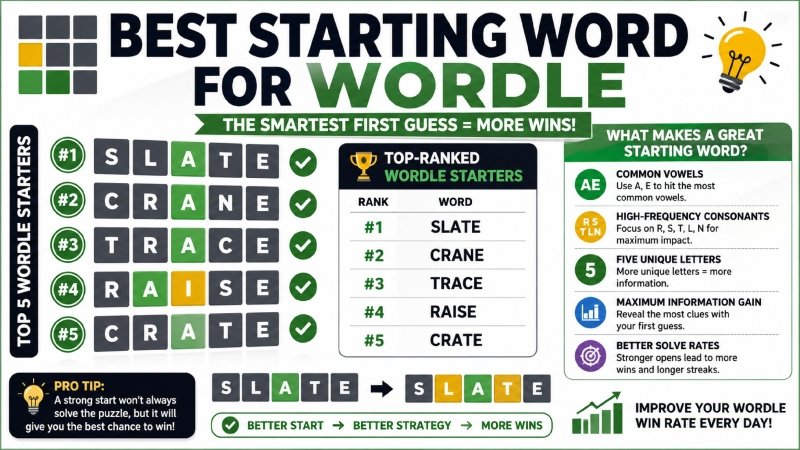
The effectiveness of a starting word depends on the information it provides. The goal of the first guess is not necessarily to solve the puzzle immediately. Instead, it should reveal as much useful information as possible. A strong opening word generally contains common vowels such as A and E. It also includes frequently used consonants like R, S, T, L, and N. When these letters appear in your first guess, you increase the likelihood of uncovering correct letters or positions.
Another important factor is letter uniqueness. A starting word with five different letters allows you to test more possibilities at once. Repeated letters often reduce the amount of information gained from the first attempt. Words such as SLATE, CRANE, TRACE, CRATE, and RAISE frequently appear in discussions about the best starting word for Wordle because they satisfy these criteria exceptionally well.
Why Your First Guess Has a Major Impact
Many players underestimate the value of the opening move. Wordle only allows six guesses, so every attempt matters. When your first word reveals multiple letters, the remaining guesses become much easier. You can quickly eliminate impossible combinations and focus on realistic answers. On the other hand, a poor first guess may reveal very little, forcing you to spend additional turns gathering information.
The first guess influences:
| Factor | Strong Starting Word | Weak Starting Word |
|---|---|---|
| Letter Discovery | High | Low |
| Vowel Coverage | Excellent | Limited |
| Elimination Power | Strong | Weak |
| Average Solve Rate | Better | Lower |
| Decision Making | Easier | More Difficult |
This is why experienced players spend time finding the best starting word for Wordle rather than choosing a random word every day.
Top Starting Words That Consistently Perform Well
Several words stand out because they provide excellent information and balance.
SLATE
SLATE is often considered one of the strongest opening choices available. It combines two common vowels with three frequently used consonants. Every letter contributes meaningful information. Players appreciate SLATE because it works well regardless of the puzzle’s difficulty. It is a reliable option for beginners and advanced users alike.
CRANE
CRANE has remained a favorite among Wordle enthusiasts for years. The word contains common letters and offers excellent coverage. Its balance of vowels and consonants makes it highly effective for identifying patterns early in the game.
TRACE
TRACE delivers similar benefits while providing slightly different letter combinations. Many players rotate between TRACE and CRANE depending on their preferred strategy. The word helps uncover common consonants and frequently appears near the top of analytical rankings.
RAISE
RAISE focuses heavily on vowel discovery. Since vowels often play a critical role in solving Wordle puzzles, this word can provide valuable insights immediately. Players who prioritize identifying vowel placement often favor RAISE over other options.
CRATE
CRATE combines many of the strengths found in the other top choices. It includes high-frequency letters and offers strong elimination power during the first move. For many players, CRATE represents a balanced approach that works consistently across different puzzles.
How Data Supports These Starting Words
Researchers and Wordle enthusiasts have analyzed thousands of Wordle solutions to determine which letters appear most frequently. The letters E, A, R, T, S, L, and N consistently rank among the most common. The best-performing starting words often include several of these letters.
Statistical analysis shows that words featuring common vowels and consonants tend to reveal more useful information than words containing rare letters. This is why expert recommendations frequently center around similar word choices.
Comparing Popular Starting Words
Different starting words offer different advantages.
| Word | Vowel Coverage | Common Consonants | Information Gain | Beginner Friendly |
|---|---|---|---|---|
| SLATE | High | Excellent | Excellent | Yes |
| CRANE | High | Excellent | Excellent | Yes |
| TRACE | Moderate | Excellent | Very High | Yes |
| RAISE | Very High | Good | High | Yes |
| CRATE | High | Excellent | Very High | Yes |
Although each word performs well, SLATE and CRANE often receive the highest overall ratings because they balance vowel coverage and consonant frequency exceptionally effectively.
Pros and Cons of Using a Fixed Starting Word
Many successful players use the same opening word every day. Others prefer rotating between several options.
Common Mistakes to Avoid
Many players unknowingly reduce their chances of success by making poor opening choices. One common mistake is choosing words with repeated letters. Testing two identical letters during the first guess limits the amount of information collected.
Another mistake is relying on uncommon letters such as Q, X, Z, or J. While these letters occasionally appear in Wordle solutions, they occur far less frequently than letters like E, A, R, and T.
Best Practices for Individual Users
Individual players should focus on consistency and efficiency. Start with a proven opening word that includes common vowels and consonants. After the first guess, avoid repeating letters that have already been ruled out. Use each additional guess to test new possibilities whenever possible.
Best Practices for Technical Teams and Data Enthusiasts
Technical teams often analyze Wordle through probability models and statistical simulations. Instead of evaluating words based solely on familiarity, they measure information gain. This approach examines how many possible solutions remain after each guess.
From a data perspective, the strongest opening words are those that eliminate the largest number of possibilities. Words such as SLATE, CRANE, and CRATE consistently perform well because they maximize useful feedback.
Is There a Single Perfect Starting Word?
The search for the perfect answer continues to spark debate among Wordle fans. While some studies identify SLATE as the best starting word for Wordle, others favor CRANE, TRACE, or SALET based on specific methodologies.
The reality is that several words perform exceptionally well. Differences between the top choices are often small. What matters most is selecting a strong word and applying an effective strategy afterward.
Frequently Asked Questions
What is the best starting word for Wordle?
SLATE is widely considered one of the strongest options because it contains common vowels and consonants that reveal useful information early.
Why do many players use CRANE?
CRANE offers excellent letter coverage and helps identify common letters quickly, making it a reliable opening choice.
Should I use the same starting word every day?
Many successful players do. Consistency helps develop a repeatable strategy and improves decision-making.
Are words with repeated letters bad starting choices?
They are usually less effective because they test fewer unique letters and provide less information.
Do mathematical analyses agree on the best opening word?
Not completely. Different studies produce different results, but SLATE, CRANE, TRACE, RAISE, and CRATE consistently rank among the strongest options.
Conclusion
Finding the best starting word for Wordle can significantly improve your performance and make daily puzzles easier to solve. Strong options such as SLATE, CRANE, TRACE, RAISE, and CRATE provide excellent letter coverage, reveal critical information, and help eliminate possibilities quickly.
The most successful players focus on information gathering rather than immediate solutions. Choose a proven starting word, analyze the feedback carefully, and make each subsequent guess count. By following a consistent strategy and avoiding common mistakes, you can improve your solve rate, maintain longer winning streaks, and enjoy a more rewarding Wordle experience every day.